The National Staff Development Council defines professional development as “a comprehensive, sustained, and intensive approach to improving teachers’ and principals’ effectiveness in raising student achievement.” They say professional development should be aligned with student state standards, conducted by educators (or knowledgeable well-prepared individuals), and take place more than a one-and-done session (initially several times a week).
The majority of the professional development sessions I have attended have met some, if not all, of the criteria at one point or another. So does that alone make them great? How does one truly define a *great* professional development?
When I first looked at this blog prompt my first instinct was to write about a great professional development sessions I gave. In the fall as part of my Study Group Coach grant obligations for the Chicago Foundation for Education I presented at their Teachers as Leaders and Learners Conference. This was my third year presenting at this conference. In fact, I was fortunate enough to have a lady approach me and say that she was excited I was presenting since she had seen me present before and would be in any session I taught that day because of her past experience with other sessions I lead. That sure was nice to hear.
I lead a session based on my Study Group, “The Web 2.0 Classroom.” It was well attended in both sessions. There was audience participation. One teacher reached out after the session for additional resources (which I spent my break at the conference researching for him). Why would I think of this session as a great professional development? Maybe it was because I was so energized and into the presentation that the vibe rubbed off on the participants. Maybe it was because I was able to provide them with resources they could immediately use. Maybe it was because they wanted and chose to be there so they were more receptive. In any case, in my opinion it was a great professional development. CFE does a great job of providing feedback to its presenters. I’m anxious to see the comments of the participants to see if their thoughts mirrored mine.
In terms of a professional development session that I’ve attended that I found to be great I would have to say there are two related to the current masters program I am in. These two workshops t have proven to be beneficial to my current position as a Lead Technology Teacher. The Web 2.0 and Digital Storytelling workshops were considered great for the following reasons:
*they provided me with knowledge I did not have (many of the professional development sessions I attend are things that I already know, or could have easily managed without the pd)
*they were relevant to my current teaching assignment (many of the pds I attend relate more to classroom teachers)
*they were presented by knowledgeable people that clearly researched and knew the content, and
*they were easily accessible and immediately transferable
Monday, February 8, 2010

Tuesday, January 26, 2010
Technology: Isolated or Integrated?
Should technology (computer skills, typing, software instruction, etc.) be taught as separate skills or as part of an integrated lesson? This is the question that is on the table this week in grad class. Seems fairly easy, yet not so easy to answer. In reality? I think it depends on the scenario, the assignment, and the students. For example a group of students working on the Adobe Youth Voices project needed to learn Premiere Elements in order to create their videos. There was minimal software instruction. I showed the students the layout of the software and the mechanics of importing media. From there the students basically figured it out, for lack of a better term.
Now that being said, in some respect their knowledge base was more limited by this approach. If they were lazy or not really into the project they simply did the bare minimum and stopped. If they were really into the project they constructed their own knowledge- they would play around to figure out how to do what they wanted to do, thus creating a far better project than the other students. If I was to teach the technology in isolation the “lazier” students would gain more knowledge. But would they more advanced group be itching to figure it out and move ahead to actually start their projects?
On the flip side there have been instances where technology in isolation was appropriate. Back in high school I learned how to type in isolation. Not glamorous, and at the time boring as hell. But…..that skill is one that is invaluable to my current job. In this particular instance I feel as if having a lesson looming while I was trying to learn the mechanics of typing would have been distracting and that I may not have learned to type as accurately as I did being taught in isolation.
So….should technology be taught in isolation or as part of an integrated lesson? In a word…..sometimes.
Saturday, January 23, 2010
Less Than Stellar Professional Development
The phrase “professional development” in the educational system is often met with a rolling of the eyes and a sigh from educators. Why is this? Is the common educator truly not interested in furthering their knowledge and skills? I do believe that is the case with some, but I don’t feel it is the case for the majority of professionals in the field. Why then is it such a struggle to find a happy medium? Here are some thoughts:
1. Many PD sessions are “one and done” or as stated so lovingly in the suggested reading by our professor, “spray and pray”. Most professional development sessions are conducted one time, usually to a mass group of people, with no follow up.
2. When constructed for entire faculties at one time many participants will have no use or relevance for the information presented.
3. Reflective of points 1 & 2, many participants are forced to attend these sessions, whether to acquire recertification credits or because the administration makes it mandatory.
4. In my experience many PDs seem as if they were thrown together at the last minute rather to fill time than to address individual needs by the faculty.
Our assignment for this blog post was to talk about the last awful professional development session we attended and why. The first example that came to mind was bad, but not for the reason that one might think.
Our school system has many tools available for our teachers to gain access to student data. The training session took place at our school in our computer lab. (Which leads to yet another compelling question: are the teachers completely “there” or are they distracted by the familiar surroundings, feeling more at ease with doing things other than what is in front of them?). There were two presenters from Chicago Public Schools conducting the session. One was presenting how to access the data through our intranet while the other walked around and made sure everyone was able to gain access.
Before the training began there was no assessment as to whether teachers had gained access to this site before or not. For those that had, they had little use for this information again (the information was an overview of how to access and manipulate the student data. For those who did not have classrooms of students, there was little relevance as well. These factors alone may have contributed to the reason I selected this as an awful professional development session. But honestly? They didn’t. My colleagues did. As the presenter was conducting the session there were many faculty members talking. More than once the presenter had to ask people to stop. Then there were those that chose to do other tasks, such as enter grades in the on-line gradebook. It reached a point that the presenter made a somewhat demeaning comment when she talked about how she liked the computer lab layout; she could see everyone’s screen at the same time. While this was a polite way of her asking us to get back on track I wondered: was this statement more demeaning for her? Or for us?
I felt extremely embarrassed for her. I felt extremely embarrassed for myself. Although I made sure to let her see I was paying attention the entire time (even though this pd had absolutely no relevance for me) I was embarrassed for the fact that some of the teachers help to fuel the stereotype that Chicago Public School educators are ignorant. While the content of the professional development isn’t what made it bad, the behavior of the crowd did.
Monday, January 18, 2010
J.P. Guilford
Joy Paul Guilford by Nicole and Shane

Structure of Intellect: Then and Now
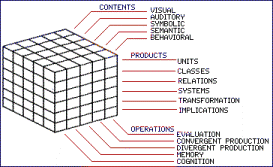
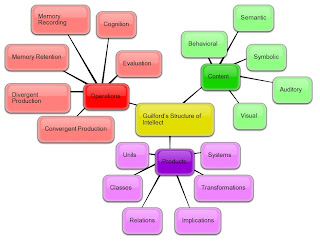
Theory in the Classroom
J.P. Guilford believed that with all the emphasis on testing students would not be taught to be creative when he stated:
"the quest for easily objectifiable testing and scoring has directed us away from the attempt to measure some of the most precious qualities of individuals and hence ignore those qualities.
Sources:
http://www.nap.edu/html/biomems/jguilford.pdf
http://www.indiana.edu/~intell/guilford.shtml
http://wapedia.mobi/en/J._P._Guilford
http://www.byuipt.net/wests/rick/2008/01/12/our-creative-society-the-visionary-jp-guilford-in-1950/
Web 2.0 Applications:
http://blabberize.com
http://bubbl.us/
http://www.wordle.net

Structure of Intellect: Then and Now


Theory in the Classroom
J.P. Guilford believed that with all the emphasis on testing students would not be taught to be creative when he stated:
"the quest for easily objectifiable testing and scoring has directed us away from the attempt to measure some of the most precious qualities of individuals and hence ignore those qualities.
Sources:
http://www.nap.edu/html/biomems/jguilford.pdf
http://www.indiana.edu/~intell/guilford.shtml
http://wapedia.mobi/en/J._P._Guilford
http://www.byuipt.net/wests/rick/2008/01/12/our-creative-society-the-visionary-jp-guilford-in-1950/
Web 2.0 Applications:
http://blabberize.com
http://bubbl.us/
http://www.wordle.net
Saturday, August 8, 2009
TIE 542 Reflective Blog

During the summer of 2009 I participated in a masters course titled "Digital Internet Resources for Teaching" through National-Louis University. Throughout this compacted course we covered a lot of ground. Luckily I was familiar with the software that was used so I didn't experience the anxiety that some of my colleagues did. Below is a link to the site I developed for this class, as well as a summary of my thoughts on the experience.
Blogs

Writing the blogs was a good experience, and a good opportunity to have to sit down and really think about what I wanted to say surrounding each topic. One of the difficult parts was the 'requirement' that I had to read other classmate's blogs and post to those as well. There were times when I had to really rack my brain to come up with something to say to others. I liked that there were a series of topics to choose from and that I had the freedom to blog about my trip to Stanford. In all, it strengthened my skills with this blogging tool which will enable me to help my teachers.
Hot Links

I enjoyed putting the hot links together the most. I have "lists" of links all over the place and tried to consolidate them here. While I know that I will likely create more links, this will provide me with a 'quick win' for my teachers. The format I developed is clean and easy to read. The only drawback would be for someone with a very slow computer connection, as there are a ton of images.
Sampler Site

I enjoyed completing the sampler site as well. While I knew how to complete many of the tasks that we added into our sample, it was a nice refresher for those skills that I hadn't used in a while. It also was a major help that we completed many of these tasks in a face to face format. The only thing that would have been better was to have a set of tips/tricks/reminders for each task. I found myself scribbling shortcuts in my notebook...keep your fingers crossed that I'll actually remember what they go to.
I.Q. Rubric and Webquest

Of all the projects, this was my least favorite. There was a lot of work involved looking at various webquests around a common theme. I found it slightly difficult to get started until I settled on a webquest about fairy tales. Even though I didn't necessarily enjoy this it will provide a valuable list for the teachers in my building that teach this topic.
Final Project

My final project centered on my time and work with the Adobe Youth Voices project. I was grateful to the instructor for letting me focus on this topic, as I am sure to use it. I was very happy with the design and the overall flow. I wish that I could have had more time to work, but I am sure to use my own webquest when I begin the program again.
Overall, I highly enjoyed this class. The work load was slightly difficult since it was condensed into a six week course as opposed to ten weeks. I could have very easily used more time. However, we created content that will help me in my role as a Lead Technology Teacher, which has proven extremely valuable.
Wordle
<
It’s a great time to be an educator. When I first began my teaching career the Internet was incredibly limited (aka the ole’ “web 1.0”). If I needed lesson plans my main option was “ERIC” references (and I’ll tell ya it was a heck of a way to get a masters degree years ago).
Today’s educators have literally millions of resources they can choose from to supplement or drive their curriculum. Many of these are a part of the new “web 2.0” firestorm.
While there are so many worthwhile applications, I’d like to share one of my absolute favorites: Wordle.
Wordle is a computer generated “toy” (their description) that generates word clouds with text that you supply. There are limited fonts, layouts, and color schemes, but these can be changed by the user. No password is needed, no software t o be installed. You can post your work to their gallery as well, although I would not recommend it, or sending students there for that matter. Wordle is NOT moderated to contain educational content only, so I direct my students to the ‘create’ tab and keep them away from everything else.
Here are some pictures of Wordles I’ve produced based off of student content:


Some educational suggestions:
Students write a summary of something they have studied
You create a wordle on a topic that you will discuss and have the students predict what they will learn
Introduce vocabulary
Synonyms (or antonyms)
Wordle Websites:
http://languagesresources.wordpress.com/2009/05/07/23-ways-to-use-wordle-in-the-mfl-classroom/
http://clifmims.com/blog/archives/2626
http://www.slideshare.net/JenniferW/wordle-ideas
http://groups.google.com/group/wordleusers/browse_thread/thread/c87eb88e04996dbc/326b60e156452169
http://www.minsmind.com/2009/06/ways-to-use-wordle-in-your-classroom.html
http://jeffreyhill.typepad.com/english/2009/04/twentyfive-interesting-ways-to-use-wordle-in-the-classroom.html
And...the lazy man's Wordle video....
Tuesday, August 4, 2009
My Journey to the Adobe Youth Voices Summit

July 28, 2009. Night before the Adobe Youth Voices Summit in Palo Alto, California at Stanford and I’m finally getting excited to go. We didn’t manage to get the required pre-summit video together. Too many road blocks. I’m worried that the kids won’t show at the airport tomorrow (worried about one more than the other).
July 29, 2009. Both boys show at the airport! They are on their way to California, having never flown before. I wonder what is going through their minds at this point. I’m “twittering” the trip. We get here and I ask one of the boys if he has brought a uniform shirt (they asked for some nicer clothes for some of the events). He says no…even though I have sent at least 3 emails indicating this. I get angry, and have to remind myself that not all children are reared in the same manner. I have to remind myself that it’s not that big of a deal. I’m more upset about the fact that he didn’t read the emails, but again, a self-reflection hits me that even at 12/13 years old these children still need to be educated on life skills and responsibility. It makes me feel grateful that I have done this with my own children since they could walk. I tell both boys that they need to use “church manners” on this trip and that we will see people from 14 different countries here; each dressing differently and speaking differently. I remind J that he needs to remove his ear buds when people are speaking to him….We haven’t even begun any formal training and I’m exhausted. Tonight we meet for dinner, and then complete an activity that allows us to meet members of small groups we will be assigned to. Each member receives pieces to one of five puzzles. The goal? Find members of the group that have the same puzzle pieces as you. After doing so, put the puzzle together to receive a clue as to which workshop you will be a part of. My housemates? Educators from Belarus, Uganda, and New York. Holla!

July 30, 2009. During the opening session this morning many of the students are quietly sitting by their teachers. Most are still shy at this point. Our speaker is David Nakabayashi, Creative Director in the in Art/Visual Effects department at Lucasfilm. He speaks to us about his filmmaking background and encourages the students to stay focused with storytelling and getting their message heard. He even shows us clips for a documentary that he has been working on for 5 years, leaving the audience with his top 5 tips: technology doesn't replace creativity, always keep your audience in mind- make it mean something, failure is not an option...but it's gonna happen anyway, love it, hate it, but finish it, and have fun. Excellent advice.
Broken into our groups, we attend individual workshops. My group is working on using Photoshop and After Effects to animate still images. Few people were familiar with how to prep our pictures within Photoshop. As our leader isn’t an educator, he tells people verbally what to do, without demonstrating on the LCD. It takes only a minute for him to rush around the room scratching his head because we are all at different stages. We are frustrated, he is frustrated. There is also an assumption that everyone coming in has used Photoshop. Many have not. Add to that about 5 other languages that are spoken in the room. To make matters worse, Adobe pulls the educators to attend a best practices breakout session of our own. So….we began a process and didn’t finish it. I was incredibly curious to see how to animate. Still don’t know.
During the educator session we are once again broken into smaller-bite-size groups. In these sessions we share our media pieces and get a chance to talk about what we did with our AYV programs. A good session, but would have been better if there would have been more specific questions such as: how did the students select the topics, how many students, during school or after school, what programs did you use to create your piece, etc.
The session ends, and many of the educators sneak off campus for the night (my pics of this are on Facebook).
July 31, 2009. Today we begin the day traveling to Adobe’s headquarters for workshops. It’s difficult to know which workshops to sign up for, as we had to sign up for them weeks ago, with no real description of each. Are they beginner classes? Is it assumed you know the featured program already? I attend a Photoshop session which turns out to be a beginning level class, taught by a lady who is getting frustrated with the kids because they aren’t listening as closely as they should be. Lucky for me, I sat with another teacher from San Jose that knew a good deal about Photoshop, so we moved on ahead of everybody else. What was cool about that is two Photoshop developers wander over to us and show us all sorts of cool features (which of course I remember none of now...)
We leave Adobe and travel to Dreamworks Studios. There are four speakers: the first shows us new 3D animation from Kung Fu Panda, Monsters vs. Aliens, and Madagascar. Very cool. The speaker also shows us how the story boards for Madagascar were developed, and shows story boards of deleted scenes. Next, an art director explains how the art is created and drawn up before the movies are animated. Finally, a director speaks to the group about how they should “follow their bliss” and takes questions about internships. In all, there was far too much sitting and being talked to. We were all disappointed that there was no type of tour and the kids didn’t receive any sort of souvenir to take back to their countries. Everyone boards the buses back to Stanford, except for me and another teacher who head to San Francisco for a Giants baseball game, followed by another late night downtown.

August 1, 2009. This morning we meet “Black Nature”, a refugee from Sierra Leone that has become famous for both the struggles he has endured and the music he has made from forming the band Refugee All Stars. Impressive. We also learn more about an organization that was founded to help other countries to promote their music: weowntv.org.
There are more breakout sessions. This time I attend one on Creating Real Community Impact. Didn’t learn much, not very impressed. Instead of sticking with the group and heading to the cafeteria, four of us sneak off for lunch at In and Out Burger. After lunch is the closing session with housekeeping items and certificates of completion.

Tonight is the Adobe Youth Voices Live! Program in San Francisco. Very similar to our gala at the Museum of Contemporary Art. Many students from the Boys and Girls Club in the Bay Area perform outstanding dance moves, as the Black Eyed Peas come on stage to sing/dance. They talk about a partnership they have formed with Adobe Called “The Black Eyed Peas Peapod” program, promoting youth getting their message out through music. Afterwards, we hear from select students and see their work. Little did I know, there would be a celebrity among us: OUR VERY OWN SHANE JONAS’ AYV project from Kellman is shown on the screen. Holla!! I’m busy texting Shane swear words because I can’t believe I’m watching his clip sitting in San Francisco!! In between texts I’m telling everyone around me that Shane is my bud. They roll their eyes....


After outstanding media, we head to the gala celebration room. The room is stunning. Everything is red and white. There is a gigantic screen which runs a one minute piece that many of the students had completed. There are huge boards with different colored markers where kids can leave messages. A candy bar, an ice cream bar, a cookie bar. I need to get on a treadmill.


On the way home, our bus is alive. Students from around the globe singing karaoke on the p.a. system. We heard copulations of everything from Sponge Bob Square Pants to Snoop. Two boys rapped in their native tongues: absolutely brilliant Allan from Uganda (who will attend MIT next year) to a boy from Jordan that was a presence throughout the entire summit. I’m waiting for someone to share the inevitable YouTube version…
Back to Stanford at midnight, back in the car downtown for some goodbyes with my new friends from Uganda, England, New York, San Francisco, and Canada.

In terms of soft skills, I’d say the Summit was a success. It is great that Adobe placed so much emphasis on storyboarding and the major emphasis on creating with purpose. Hard skills? A disappointment. Being new to the program and not having a background in video production, I was disappointed that there weren’t more opportunities to learn more skills- especially for schools new to the program. I also felt there was far too much sitting and listening in a lecture format. There were approximately 66 students there, with about 40 or so coming from countries where English is not their first language. For me the most valuable piece was the late night excursions away where real teachers sat together and talked about our success, failure, and ideas. There will be greater collaboration amongst the educators there because these side trips took place. In fact, on the second day of the Summit one of the teachers asked Adobe to give us an email list for the teachers. They basically gave a run around and tried to avoid the question. But…by the end of day 4, everyone had signed an email sheet that was passed around by one of the teachers without reservation. By the end of day 5, everyone was saying goodbyes and saying they couldn’t wait for the list to be distributed…
As for my students, they were the youngest ones there. The two other girls from Chicago were 8th graders moving into high school this year. We were the only two elementary schools in attendance. For one of them, the trip was probably life altering. The other one was far more reserved, but who knows what was going through his mind. Either way, two students from the West Side of Chicago got a chance to spend five days at Stanford, learning how teens from around the world are just like them.
Subscribe to:
Posts (Atom)
